
Renting a car and driving through the scenic English countryside—from the historic streets of Oxford to the breathtaking cliffs of the Seven Sisters—is a dream road trip for many travelers.
If you are a visitor navigating British roads, stopping by a Motorway Service Station (commonly signed simply as “Services” or “Motorway Services”) is an essential part of the journey. While they offer standard amenities like food courts and Costa Coffee, they also have uniquely British quirks. For instance, you might stumble upon a mini-casino area inside the service station, restricted to adults aged 18 and over, filled with slot machines—a sight you rarely see at highway rest stops in many other parts of the world.
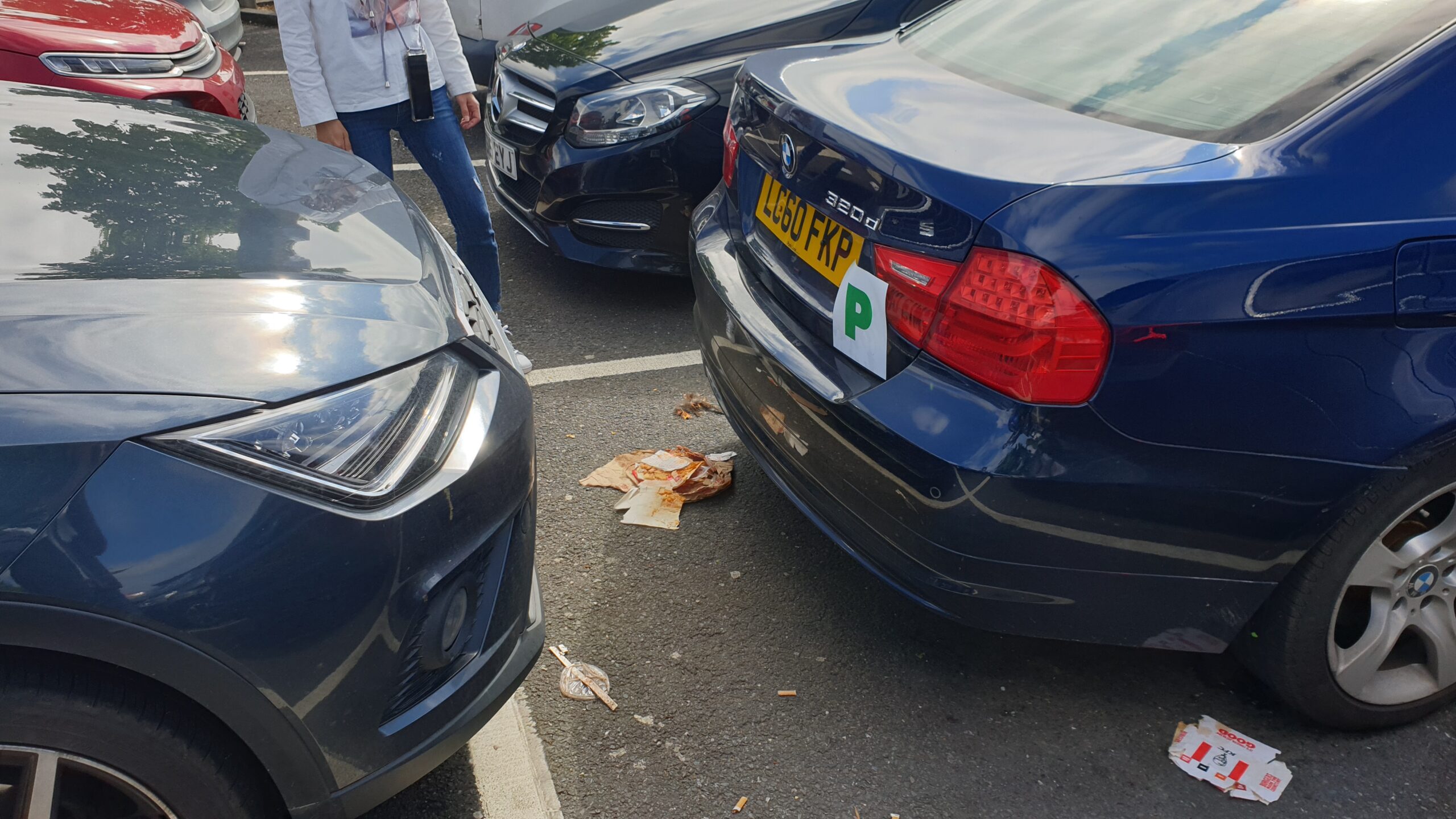
Another unique detail you’ll spot on British roads is the “P-Plate” (Probationary Plate). Unlike the mandatory “L-Plate” for learners, a green “P” sticker on the front and back of a vehicle indicates that the driver has recently passed their test and is still gaining confidence on the road.
But what happens if you are sitting peacefully in your rental car at a motorway services parking lot, enjoying a quick bite, and another vehicle suddenly bumps into you? Worse, what if the other driver acts defensive, aggressive, or tries to walk away without a word?
Based on a real, frustrating encounter I recently experienced at an English service station, here is a complete guide on how to protect your rights, deal with uncooperative drivers, and navigate England’s Road Traffic Act laws as an international traveler.
🎬 The Incident: An Unwelcome Surprise at the Parking Lot
During a recent road trip, my family and I pulled into a motorway service station for lunch. After grabbing some food at Burger King (interestingly, menus in the UK strictly list them as “Burgers” rather than “Hamburgers”), we decided to eat inside our rental car to stay comfortable.
Suddenly, I felt a loud “THUD“ shake the vehicle.
Another car trying to pull into the adjacent parking space had completely missed the braking point, hitting us from behind. The impact was strong enough to violently jolt everyone inside, leaving my family in shock.
When I got out to assess the situation, the third-party driver simply glanced at both cars, said absolutely nothing, offered no apology, and walked straight past me into the service station restrooms.
While I stood there in disbelief, a local British bystander who witnessed the entire event approached me, expressing shared outrage at the driver’s appalling lack of manners. Sensing that things might get complicated, I asked the bystander if they would be willing to act as an independent witness. The local kindly agreed and exchanged contact details with me.
When the third-party driver finally returned from the restroom, I politely mentioned that the impact was significant and we needed to exchange insurance details. Instead of apologizing, the driver flew into a rage, shouting aggressively and acting incredibly defensive. Refusing to hand over any contact info, the hostile driver quickly got back in their car and drove off, leaving me deeply frustrated and taken aback.
🛑 1. Debunking the Myth: “No Visible Damage Means We Can Just Walk Away”
When incidents like this happen, well-meaning locals or expats might tell you: “In the UK, if there is no visible cosmetic damage or cracked bumpers, people usually just shrug it off and drive away.”
In fact, my acquaintance told me the exact same thing over the phone during the chaos. However, this approach is merely an informal method preferred by some local drivers who worry about premium hikes or the impact on their No Claims Bonus (insurance discounts). It is not a legal rule.
Under English law, if an accident causes damage to another vehicle or property, or results in an injury, drivers are legally required to stop and exchange details. Walking away or refusing to provide information isn’t just rude—it can be classified as a criminal offense under UK law, specifically “Fail to stop” and “Fail to report an accident.” According to official guidelines on Police.uk, failing to stop or report an incident can lead to hefty fines, penalty points on a license, a driving ban, or even up to 6 months in prison depending on the severity.
📋 2. What You are Legally Entitled to Demand at the Scene
According to Section 170 of the Road Traffic Act 1988, if you are involved in a collision in a “road or other public place” (which includes public motorway service parking lots), you have the legal right to demand the following information from the other driver:
- The driver’s full name and current residential address.
- The vehicle’s registration number (License plate).
- The name and address of the vehicle owner (Crucial if they are driving a rental, a company car, or a vehicle belonging to a relative).
⚠️ The Rule on Insurance Details:
Many travel blogs state that you must get the insurance policy number right at the scene. Legally speaking, the strict statutory obligation to provide insurance certificates or policy details at the roadside is triggered if someone has been injured or is suspected of being injured.
If personal injury is caused or suspected, you have the right to request their certificate of insurance or valid proof of coverage. If the other driver fails to produce it at the scene or refuses to cooperate, the safest and most effective step is to report the incident to the police immediately to establish an official, legal record.
🛣️ 3. Bonus Driving Tip: Understanding the UK’s “Hard Shoulder” vs. “Soft Shoulder”
When driving on British motorways (like the M40 or M25) or rural A-roads, you will frequently encounter terms related to the roadside shoulders. Knowing the difference between a Hard Shoulder and a Soft Shoulder is critical for your safety, especially if you need to pull over after an accident or a breakdown.
1. The Hard Shoulder (Solid Paved Shoulder)
- What it is: A dedicated, permanently surfaced (asphalt or concrete) lane on the far left of a motorway.
- When to use it: It is strictly reserved for emergencies only—such as a severe mechanical breakdown, a medical emergency, or if the police order you to pull over. You must NEVER use it for a rest, a phone call, or to check a map (use a Motorway Service Station instead).
- ⚠️ The “Smart Motorway” Exception: In some parts of England, you will encounter “Smart Motorways.” On these roads, overhead electronic gantry signs can open the hard shoulder as a running traffic lane during rush hours. Look at the signs carefully: If a lane has a Red X, or if the speed limit is blank, do not enter it unless it’s an absolute emergency.
2. The Soft Shoulder (Unpaved/Grass Shoulder)
- What it is: Usually found on rural, unlit A-roads or B-roads rather than major motorways. It consists of unpaved ground, gravel, grass, or mud alongside the road.
- When to use it: You should avoid pulling onto a soft shoulder unless it is an absolute emergency. Because the ground is soft and unpaved, your rental car can easily sink into the mud or lose traction on the loose gravel, causing your vehicle to become stuck or even flip if you pull over at a high speed.
- Signs to watch for: Look out for the rectangular white sign with black text that says “Soft Verges” or “Soft Shoulders.” If you see this, keep your vehicle on the main tarmac road.
💡 Safe Breakdown Protocol in the UK:
If you have an accident or breakdown on a UK motorway and manage to pull into a Hard Shoulder:
- Pull as far left as possible and turn your front wheels facing away from the motorway.
- Turn on your hazard lights (and sidelights if it’s dark or foggy).
- Crucial UK Rule: Do NOT stay inside the car. Every passenger must exit through the left-hand doors (away from traffic) and stand behind the metal crash barrier, up on the grass verge.
🛠️ 4. Step-by-Step Action Plan to Protect Your Rental Insurance
If you ever find yourself facing a hostile or uncooperative driver on a UK road trip, stay calm and follow these steps recommended by UK police and consumer advice bodies (like Citizens Advice):
1.Stop & Secure:Safety First.
Even inside a parking lot, switch off your engine and turn on your hazard lights. Check if you, your passengers, or the other party have sustained any immediate injuries.
2.Exchange Info:Required by Law.
Politely ask for the driver’s name, address, and vehicle registration. Make sure to double-check if the vehicle belongs to them or a third party (like a rental agency).
3.Gather Evidence:Photos & Witness.
Take clear photos and videos of the vehicle positions, the contact points, the license plates, and the parking lines. Note: Avoid posting the other driver’s face on public social media due to UK privacy laws, but keep it for evidence. Most importantly, if a local bystander backs you up—just like the kind witness I encountered—ask for their name and phone number to secure an independent witness.
4.Call 101 or Report Online:If They Flee.
If the driver refuses to give details or flees the scene, call 101 (the UK police non-emergency number) immediately while you are still at the location, or report it via the local police force’s online portal within 24 hours. If you feel physically threatened, or if there are severe injuries blocking the area, call 999 for emergency services.
5.Notify Rental & Insurance:Before Returning the Car.
Even if your rental car looks fine, minor bumper impacts can cause hidden structural or sensor damage underneath. Inform your rental company and your travel/car insurance provider right away. Your excess fee (deductible) recovery will depend entirely on the evidence you provide.
💡 Why an “Independent Witness” is a Game-Changer in the UK
In British insurance claims, the word of an unrelated third-party witness holds incredible legal weight.
Unlike some countries where dashcams are universally installed, many cars in the UK do not have them, especially in parking lots. If a dishonest driver later changes their story and tells their insurance company, “No, the rental car backed into me!” or claims it was a 50/50 split fault, the insurance companies will default to a “Knock-for-Knock” (split liability) settlement due to lack of evidence. This means you could unfairly lose your rental car excess fee.
However, a quick statement from a local British citizen saying, “I watched the whole thing; the third-party driver simply failed to brake in time” completely shuts down fake claims. If a local offers to help, always take down their contact details!
🩺 5. The NHS Myth: “Medical Treatment is Free, So There’s No Compensation”
A common misconception among visitors is that because the UK has the NHS (National Health Service), there are no personal injury claims or payouts.
First, regarding medical costs for tourists: while initial emergency treatment at an A&E (Accident & Emergency) or an Urgent Care Centre is generally free of charge at the point of use for international visitors, if you are admitted to the hospital, require follow-up outpatient care, or undergo specific scans, you will be billed up to 150% of the standard cost as an overseas visitor. This is why comprehensive travel insurance is mandatory.
Second, regardless of hospital bills, if you experience whiplash, neck pain, or psychological trauma from a collision, you are legally entitled to make a Personal Injury Claim against the at-fault driver’s insurance.
In England and Wales, small claims under £5,000 (mostly minor whiplash injuries) are processed through an official portal called the Official Injury Claim. While recent legal reforms (the Whiplash Reforms) have drastically capped the payout amounts for minor pain to prevent insurance fraud, obtaining a settlement for vehicle damage, towing costs, or your rental car excess fee is entirely possible provided you have established clear third-party fault and solid evidence.
✍️ Final Thoughts
If you ever encounter an aggressive, defensive, or uncooperative driver at a British motorway service station, do not let them intimidate you. Their behavior is not a reflection of local driving culture—it is simply a poor attempt by an individual to evade their legal obligations or a sign of an inappropriate response from a driver trying to avoid consequences.
English law is structured to protect innocent drivers. Stay calm, stand your ground, note down the registration plate, secure your local witness, and report the case to protect your peace of mind and your wallet. Safe travels on your UK road trip!